Sunday, February 27, 2011

Target Audience

To get a clear perspective of my target audience i conducted two questionnaires aimed at two different age groups, comparing and analysing the contrasts between the two.


The demographic for my questionnaires were both females and males between the ages of 18-29 and 30-50+, Overall, the results of my questionnaire I didn't find that surprising, as the main consumers of Hot chocolate drink are infact females.


My first question was aimed to find what the most common hot beverage drink was purchased. From this i found out that hot chocolate and tea were equally as popular ,and that coffee was favoured mostly my the males that answered my questionnaire, this was a positive result for us as it enabled us to find out exactly who our target audience are. Furthermore,it allowed us to make sure that our product would be successful in the market as almost 38% of the females out of both age groups we asked favored hot chocolate the most, and a small percentage said that they enjoyed drinking hot chocolate as a treat also demonstrating that our product would be successful as a regular consumption but also occasionally,although Hot chocolate was favored mainly by the females asked we also found that a small number of males enjoyed the beverage meaning that we were able to widen our target audience consumers, this so far suggests to us that perhaps females enjoy hot beverages more than males supporting the idea of the advert showing a working woman enjoying our product.

Another interesting question which brought out a variety of answers, asking "what is it you look for when buying a hot chocolate beverage in you supermarket?" This generated a range of responses such as price , type of chocolate but most common answered was the appearance of the packaging , we found out that the more appealing the packaging is the more likely it is purchased . This prompted us to make sure that our packaging was to the best standard it could be and also a reasonable price as that was the second most popular when consuming hot chocolate.


How do Males and Females Respond Differently to the consumption of Hot drinking beverages?


1) What hot drinking beverage do you purchase most often?


Hot Chocolate - 38%


tea-38%


Coffee-24%


2) What is it you look for when purchasing hot chocolate?


(in order of most common)


Packaging appeal


Price of product


Type of chocolate


3) Where do you usually see hot chocolate adverts ?


(In order of most commonly answered)


TV


Magazine advert


Billboard/Poster


Internet

Friday, February 25, 2011

Why We Choose to Do A TV Advert?

When we first got into our group we decided that we wanted to produce a music video. We thought at the time that this was best for us because we all had a good general knowledge of music genre. But when making notes of different video’s and brain storming ideas we decided that a music video would not suit our creative nature.

We then focused our ideas onto making a television advert after seeing many different advertisements from past and present television. When making a television advert we have to decide on what the product is we are going to advertise and what is the best way of showing it. We needed to do this because the main point of making television adverts is to sell the product you are advertising. If an advert is not standing out or doesn’t make the audience want the product then it is classed as unsuccessful. The best adverts are normally the most obscure ones around. The ones that stick in your mind are the ones that will be the most successful.

This is why when we create our television advert we want ours to be the one that sticks in the mind of the audience and sells the product well. To do this we will need to make sure we have used many different editing ideas, camera shots and keep the audience entertained and not want to turn it off.

Tuesday, February 22, 2011

Audience Theories

Source: Wikipedia.org

Theories:


Hypodermic Syringe Theory (1977)
TV and video games act on audiences like a direct drug injection. The audience is seen as passive and addictive. The media-makers ‘inject’ a kind of ‘instant fix’ into the viewer.
They can directly influence the audience and alter their opinions, attitude and values- (Ideology) - Propaganda.

Roland Barthes-
He was a semiotics professor around the 1950-1960’s. He said that texts can be either open or closed. Open texts can be unravelled in a numbers of ways and can have many codes. Closed texts can only really have one main code that you can derive from the text.
Roland Barthes “The Death of the Author” this links into post-modern theory

Reception Theory- The audience are actively creative in the construction of meanings from the text. They control the actual interpretation of the text (de-coding) the producer does not have the final word on what the text actually means to the audience.

Encoding and Decoding- The producer encodes the text so the audience can decode it and get what the producer of the text is trying to get across through the codes. However the audience can decode the text incorrectly; this is called oppositional reading.
There are a number of ways the audience can go when they de-code a text:

Preferred reading- This is what the producer has intended to get across to the audience and that the audience have decoded it correctly.

Negotiated Reading- Audience agrees with certain elements but not all of the text.
Oppositional Reading- This is when the audience disagree with the ideology or text or de-code it in a manner that was not intended.

Effects Debate- Does it actually make the audience at in certain ways? - Children act in certain ways that characters they see in films and on their video games.
In both of these debates they assume the audience is passive (letting themselves influenced by the media text they are taking in).

Uses and Gratification- In this theory the audience do have an active role in choosing which text to engage with and what aspects of those texts.
With reference to the uses and gratification theory, target audience may well use my text as a means of discovering the latest fashion in clothing/ music/ technology, etc.

Monday, February 21, 2011

TV Advertisement Research

A television advertisement or television commercial, often just commercial, advert or ad-film is a span of television programming produced and paid for by an organization that conveys a message. Advertisement revenue provides a significant portion of the funding for most privately owned television networks.

The vast majority of television advertisements today consist of brief advertising spots, ranging in length from a few seconds to several minutes (as well as program-length infomercials). Advertisements of this sort have been used to promote a wide variety of goods, services and ideas since the dawn of television.

The effect of commercial advertisements upon the viewing public has been successful and pervasive.

In many countries, including the United States, television campaign advertisements are considered indispensable for a political campaign. In other countries, such as France, political advertising in television is heavily restricted and some, like Norway, completely ban it.

Many television advertisements feature catchy jingles (songs or melodies) or catch-phrases (slogans) that generate sustained ideas, which may remain in the minds of television viewers long after the span of the advertising campaign. Some of these ad jingles or catch-phrases may take on lives of their own, spawning gags or "riffs" that appear in films, television shows, magazines, comics, or literature. These long-lasting advertising elements may be said to have taken a place in the pop culture history of the demographic to whom they appeared. An example is the enduring phrase, "Winston tastes good like a cigarette should", from the eighteen-year advertising campaign for Winston cigarettes from the 1950s to the 1970s.


History

The first television advertisement was broadcast in the United States on July 1, 1941. The watchmaker Bulova paid $9 for a placement on New York station WNBT before a baseball game between the Brooklyn Dodgers and Philadelphia Phillies. The 20-second spot displayed a picture of a clock superimposed on a map of the United States, accompanied by the voice-over "America runs on Bulova time."

The first TV ad broadcast in the UK was on ITV on 21 September 1955, advertising Gibbs SR toothpaste. Until the early 1990s, advertising on television had only been affordable for large companies willing to make a significant investment, but the advent of desktop video allowed many small and local businesses to produce television ads for airing on local cable TV services.

Beginning on January 2, 1971, advertisements featuring cigarettes were banned fro

m American TV. Advertisements for alcohol products are allowed, but the consumption of any alcohol product is not allowed in a television advertisement. Since the late 1990s TV advertisements have become far more diverse, and household products and foods that are not new are no longer generally advertised as they were in the mid to late 20th century. Subliminal messaging has also been banned.


Tv Advertisement in United Kingdom

In the UK, the British Broadcasting Corporation is funded by a licence fee and does not screen adverts apart from the promotion of its own future programming (either 'coming soon' or the day's later programming features). On the commercial channels, the amount of airtime allowed by the UK broadcasting regulator Ofcom for advertising is an overall average of 7 minutes per hour, with limits of 12 minutes for any particular clock hour (8 minutes per hour between 6pm and 11pm). With 42-minute American exports to Britain, such as Lost, being given a one hour slot, nearly one third of the slot is taken up by adverts or trailers for other programs. Live imported television programs such as WWE Raw show promotional material that is shown in place of U.S. advert breaks. Infomercials (known as "admags") were originally a feature of the regional commercial ITV stations from launch in 1955 but were banned in 1963.

The first advert to be shown in the UK was an advert for S.R. Toothpaste on September 22, 1955 on the ITV network (its first day).

The growth of multi-channel television has changed the face of TV advertising making the medium effective for companies with niche products and a targeted audience. 30-second advertisements on digital channels such as Sky News, MTV or E4 can be bought for less than £500000 and adverts on more targeted channels like the Business Channel, Motors TV or Real Estate TV for less than £500 per 30 seconds. New TV channels are launching every week in the UK and advertising opportunities are plentiful.

In 2008, Ofcom announced a Review of television advertising and teleshopping regulation, with a view to possibly changing their code, Rules on the Amount and Distribution of Advertising (RADA), which regulates the duration, frequency and restriction of adverts on television.
Sunday, February 20, 2011

Advertising Theory

It clarifies the objectives of an advertising campaign and for each individual advertisement. The model suggests that there are six steps a consumer or a business buyer moves through when making a purchase. The steps are:

  1. Awareness
  2. Knowledge
  3. Liking
  4. Preference
  5. Conviction
  6. Purchase
  • Means-End Theory

This approach suggests that an advertisement should contain a message or means that leads the consumer to a desired end state.

  • Leverage Points

It is designed to move the consumer from understanding a product's benefits to linking those benefits with personal values.

  • Verbal and Visual Images

Friday, February 18, 2011

Types of Advertising

The TV commercial is generally considered the most effective mass-market advertising format, as is reflected by the high prices TV networks charge for commercial airtime during popular TV events. The annual Super Bowl football game in the United States is known as the most prominent advertising event on television. The average cost of a single thirty-second TV spot during this game has reached US$3 million (as of 2009). The majority of television commercials feature a song or jingle that listeners soon relate to the product. Virtual advertisements may be inserted into regular television programming through computer graphics. It is typically inserted into otherwise blank backdrops or used to replace local billboards that are not relevant to the remote broadcast audience.


Online Advertising

Online advertising is a form of promotion that uses the Internet and World Wide Web for the expressed purpose of delivering marketing messages to attract customers. Examples of online advertising include contextual ads that appear on search engine results pages, banner ads, in text ads, Rich Media Ads, Social network advertising, online classified advertising, advertising networks and e-mail marketing, including e-mail spam.

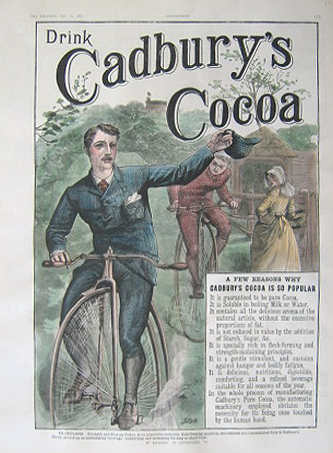
(Photograph: An early 1830's Cadburys drinking chocolate advert)


This is an example of on of Coca-Cola's popular adverts and the lengths and effort they will go to producing a brilliantly effective advert.

Tuesday, February 15, 2011

Advertising Research

Advertising is a form of communication used to persuade an audience (viewers, readers or listeners) to take some action with respect to products, ideas, or services. Most commonly, the desired result is to drive consumer behavior with respect to a commercial offering, although political and ideological advertising is also common. Advertising messages are usually paid for by sponsors and viewed via various media; including traditional media such as newspapers, magazines, television, radio, outdoor or direct mail; or new media such as websites and text messages.

Commercial advertisers often seek to generate increased consumption of their products or services through "branding," which involves the repetition of an image or product name in an effort to associate certain qualities with the brand in the minds of consumers. Non-commercial advertisers who spend money to advertise items other than a consumer product or service include political parties, interest groups, religious organizations and governmental agencies. Nonprofit organizations may rely on free modes of persuasion, such as a public service announcement.

Modern advertising developed with the rise of mass production in the late 19th and early 20th centuries. In 2010, spending on advertising was estimated at more than $300 billion in the United States and $500 billion worldwide.

Internationally, the largest "big four" (as their known) advertising conglomerates are Interpublic, Omnicom, Publicis, and WPP.


Marketing Mix

The marketing mix has been the key concept to advertising. The marketing mix was suggested by professor E. Jerome McCarthy in the 1960s. The marketing mix consists of four basic elements called the four P’s Product is the first P representing the actual product. Price represents the process of determining the value of a product. Place represents the variables of getting the product to the consumer like distribution channels, market coverage and movement organization. The last P stands for Promotion which is the process of reaching the target market and convincing them to go out and buy the product.


Rise in new media

With the dawn of the Internet came many new advertising opportunities. Popup, Flash, banner, Popunder, advergaming, and email advertisements (the last often being a form of spam) are now commonplace. Particularly since the rise of "entertaining" advertising, some people may like an advertisement enough to wish to watch it later or show a friend. In general, the advertising community has not yet made this easy, although some have used the Internet to widely distribute their ads to anyone willing to see or hear them. In the last three quarters of 2009 mobile and internet advertising grew by 18.1% and 9.2% respectively. Older media advertising saw declines: −10.1% (TV), −11.7% (radio), −14.8% (magazines) and −18.7% (newspapers ).


Niche marketing

Another significant trend regarding future of advertising is the growing importance of the niche market using niche or targeted ads. Also brought about by the Internet and the theory of The Long Tail, advertisers will have an increasing ability to reach specific audiences. In the past, the most efficient way to deliver a message was to blanket the largest mass market audience possible. However, usage tracking, customer profiles and the growing popularity of niche content brought about by everything from blogs to social networking sites, provide advertisers with audiences that are smaller but much better defined, leading to ads that are more relevant to viewers and more effective for companies' marketing products. Among others, Comcast Spotlight is one such advertiser employing this method in their video on demand menus. These advertisements are targeted to a specific group and can be viewed by anyone wishing to find out more about a particular business or practice at any time, right from their home. This causes the viewer to become proactive and actually choose what advertisements they want to view.